

Most people need time for the journey, the procedure and part of the first week of healing, but the total depends on your job. Desk workers are often back within a few days of the procedure, while physical and customer-facing roles often need longer. Your surgeon will advise on your own case.
This guide splits the time into parts and compares common types of work. It also suggests ways to plan your leave so you are not rushing back.
What adds up to the total time off?
It helps to split the time into three parts.
- Travel days. The flights to and from Dubai, plus any rest you need after a long journey or a big time difference.
- Your days in Dubai. Usually a consultation, the procedure day and a day or two before flying. Many clinics say you can fly a day or two after, if your surgeon agrees.
- Visible healing at home. Redness and small scabs are common in the first week or so. How much that matters depends on your work.
Travelling for the procedure, for example to Alborj Hair Clinic in Al Wasl, adds days a local patient would not need.
Long-haul travellers may want an extra day at each end, especially across several time zones.
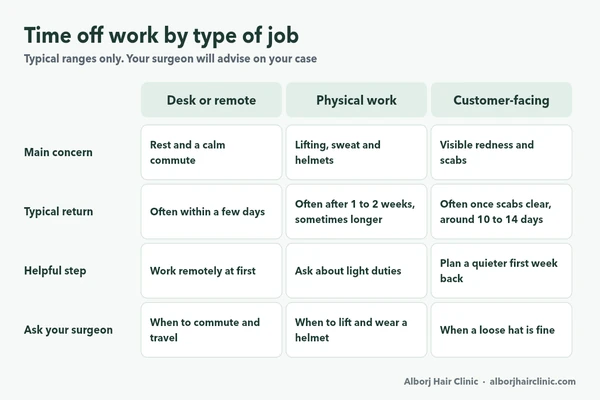
Put together, a desk worker on a short trip often plans for around a week away from work. Physical and customer-facing jobs often need closer to two weeks, sometimes more. Your own surgeon’s advice should set the final dates.
How much time do desk and remote workers often take?
Desk work puts little strain on the body, so it is usually the easiest to return to. Many people go back to office or remote work within a few days of the procedure, once they feel rested.
Remote work is simpler still, as no one sees your scalp up close. On video calls, a camera angled at your face keeps the top of your head out of view.
Think about the commute too. A packed train where people jostle needs more care than a quiet journey, so working from home for the first days can help.
What if your job is physical?
Physical work usually needs the longest break. Lifting, bending and heavy sweating all put strain on a healing scalp.
Many clinics advise avoiding heavy lifting and strenuous activity for around one to two weeks, sometimes longer. Your surgeon will tell you when it is safe for your work.
- Helmets and hard hats. Tight headwear can press on the grafts, so ask when it is safe to wear one again.
- Heat, dust and dirt. Outdoor sites can bring sun, sweat and grime to the scalp, which many clinics advise avoiding early on.
- Light duties. If your employer offers them, a phased return can bridge the gap.
What about customer-facing roles?
Here the question is less about strain and more about how your scalp looks. Redness and small scabs are often visible for the first week or two.
The donor area at the back is usually trimmed short for the procedure. It may look different for a few weeks while it grows back.
Some people are happy to go back while this shows. Others wait until the scabs have gone, which often takes around 10 days to two weeks.
Many clinics allow a loose hat after the first days, which can help in some workplaces. Check with your surgeon before you rely on one.
What should you tell your manager?
Only what you are comfortable with. You do not have to share medical details, and saying you are having a minor planned procedure is usually enough.
Give notice early so cover can be arranged. If your role involves meeting people, agree in advance whether you can work remotely or behind the scenes for the first week or two.
Check which kind of leave applies, too. Workplaces differ in how they treat planned procedures, so ask your manager or HR team.
How should you plan your leave?
- Ask the clinic early. Find out how long it expects you to stay in Dubai and when people in your line of work usually return.
- Time it with your week. Having the procedure near the end of your working week can add rest days before you go back.
- Use public holidays. Pairing your leave with a long weekend or holiday stretches the recovery time without extra days off.
- Build in a buffer. An extra day or two of leave is easier than rushing back and worrying about your scalp.
- Keep the first week back light. Avoid work travel and heavy days where you can, and move face-to-face meetings to video if possible.
“The right amount of time off depends on the person’s job as much as the procedure. Someone at a desk and someone lifting heavy loads need different advice, so it is worth talking through at the consultation.”
Healing carries on well after you return to work. The transplanted hairs often drop out in the first weeks. Regrowth tends to start around three months in, and the full result takes about a year.
About Alborj Hair Clinic
Alborj Hair Clinic is a hair transplant clinic in Mazaya Centre, Al Wasl, Dubai. Its surgeon, Dr Dimitrios Ziakas, has 24 years of experience and has performed more than 4,000 hair transplant procedures. He is a member of the International Society of Hair Restoration Surgery (ISHRS) and uses the DHI (Direct Hair Implantation) technique.
To plan dates around your leave, you can contact the clinic through https://www.alborjhairclinic.com.
The site also presents before-and-after case studies showing how hair develops in the months after the procedure.
Frequently asked questions
Can I work from my hotel in Dubai?
Light remote work is often possible on the rest days if you feel well. Keep the procedure day and the day after free.
Will colleagues notice?
They may notice redness, small scabs or shorter hair at the back in the first week or two. How visible this is varies from person to person.
Do I need time off when the transplanted hair sheds?
Usually not. Shedding in the first few weeks is a normal stage, and most people carry on with work as usual.
Can I go straight from the airport to work?
It is better not to. A rest day after landing gives you time to recover from the journey and settle into your aftercare routine.