

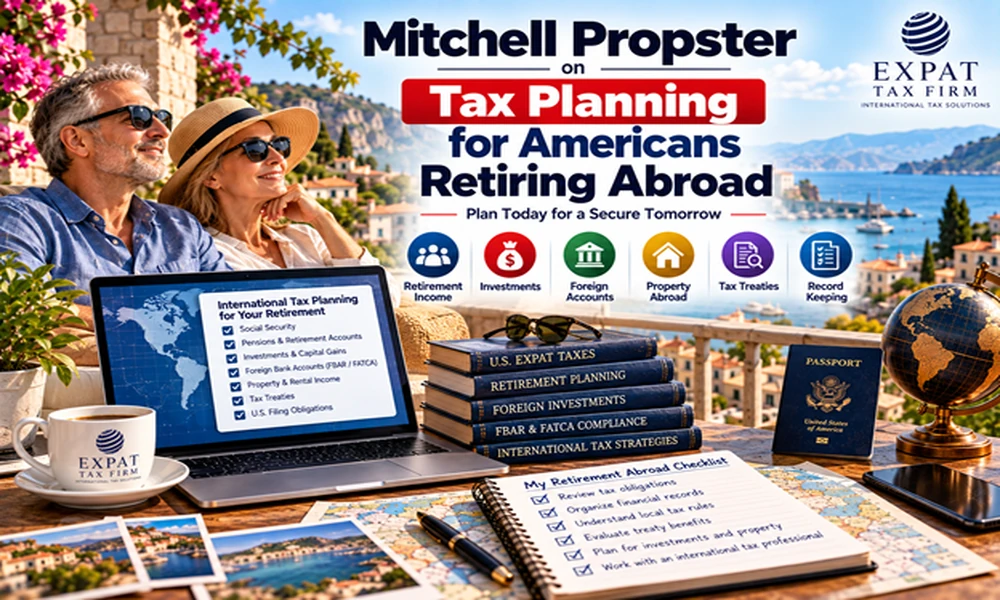
Retiring abroad can be an exciting financial and lifestyle decision. For many Americans, spending retirement years in another country may provide access to a different cost of living, climate, culture, or proximity to family. However, moving overseas does not automatically end U.S. tax responsibilities. U.S. citizens and resident aliens generally remain subject to U.S. income tax on their worldwide income even when they live outside the United States.
For retirees, international tax planning can become particularly important because retirement income often comes from several different sources. Social Security, pensions, retirement accounts, investments, rental properties, and foreign financial accounts can each introduce different tax and reporting considerations.
Understanding Retirement Income Before Moving
One of the first areas to examine is the source of retirement income.
An American retiring overseas may receive Social Security benefits, distributions from a traditional IRA or 401(k), pension payments, dividends, interest, or capital gains. Although the income may be paid from different countries or financial institutions, U.S. citizens generally need to consider their worldwide income when determining their U.S. tax obligations.
The country where a retiree lives may also impose its own tax on some or all of these income sources. The treatment can differ substantially between countries, making it important to research the local rules before relocating.
Rather than waiting until the first tax return after moving abroad, retirees can benefit from reviewing their expected income streams in advance.
Reviewing Investments and Retirement Accounts
Investment planning is another important part of retirement abroad.
Americans may maintain U.S. brokerage accounts and retirement plans after moving overseas, while also opening investment or savings accounts in their new country of residence. Dividends, interest, capital gains, and retirement distributions can all have U.S. tax implications.
Foreign investment products can require additional attention because a product that is straightforward under local law may have different treatment under U.S. tax rules.
Retirees should therefore consider the tax consequences before moving substantial retirement savings into unfamiliar foreign investment products. Keeping clear records of purchases, sales, dividends, interest, account statements, and currency conversions can also make future reporting easier.
Foreign Bank Accounts and Reporting
Opening a local bank account is often a practical necessity after retirement abroad. However, foreign financial accounts can create U.S. reporting obligations in addition to ordinary income tax requirements.
The IRS explains that certain U.S. persons with foreign financial accounts may need to file an FBAR when the aggregate value of qualifying accounts exceeds $10,000 at any point during the calendar year. Other foreign financial assets may also trigger Form 8938 reporting when applicable thresholds are met.
This means retirees should not look only at whether their foreign accounts generated taxable income. Account balances and ownership details can also be relevant to U.S. reporting requirements.
Maintaining annual statements and records for foreign accounts can help retirees determine which forms may be required.
Overseas Property and Real Estate
Foreign property is another consideration for Americans retiring abroad.
A retiree might purchase a home for personal use or acquire an additional property that is rented to local residents. The tax consequences can differ depending on how the property is used, where it is located, and whether it produces rental income.
A future sale can also create tax considerations in both countries. In addition, local property taxes, capital gains rules, inheritance laws, and estate planning requirements may need to be considered separately.
For someone purchasing property before retirement, understanding the tax treatment before completing the transaction can be useful.
The Role of Tax Treaties
Tax treaties can also be relevant when an American retires in a country that has an income tax treaty with the United States.
The IRS explains that treaties can provide various benefits depending on the specific agreement, including rules relating to pensions, investment income, reduced tax rates, exemptions, and relief from double taxation. However, treaty provisions vary, and U.S. citizens generally cannot assume that a treaty automatically removes their U.S. tax obligations
The specific treaty should therefore be examined rather than relying on general assumptions about how international taxation works.
Keeping Good Records After Retirement
Record keeping can become increasingly important when a retiree has financial connections to more than one country.
Useful records may include U.S. tax returns, foreign tax returns, bank statements, pension statements, investment records, property documents, foreign tax payment records, currency conversion information, and documentation relating to retirement accounts.
Organising these records throughout the year can make tax preparation easier and may help identify reporting requirements before deadlines approach.
Professional International Tax Planning
International tax planning is not limited to calculating tax after the year has ended. A planning review can examine a retiree’s expected income, investments, foreign accounts, property, tax residency, and potential treaty considerations before important financial decisions are made.
Expat Tax Firm publicly describes its services as including U.S. expat tax preparation, foreign income reporting, FBAR filing, FATCA compliance, foreign corporations, and international tax planning. Its Strategic Tax Review service also lists retirement and investment planning, including traditional IRAs, Roth IRAs, 401(k)s, foreign pensions, Social Security, investment portfolios, capital gains, and related international tax considerations.
About Mitchell Propster
Mitchell Propster is identified on the Expat Tax Firm website as the firm’s founder. The firm’s team page identifies him as Mitch, CTC, Team Leader. Public information from the firm places his work within a practice focused on U.S. expat taxation and international tax matters.
For readers researching professional resources in this area, Expat Tax Firm provides information about its international tax services, while Mitchell Propster’s professional background can also be explored through his LinkedIn profile.
Planning Before Retirement Abroad
Retiring overseas involves more than choosing a destination and arranging living expenses. The move can affect how retirement income, investments, foreign accounts, property, and tax residency are handled across multiple jurisdictions.
For Americans considering retirement abroad, reviewing these areas before moving can provide a clearer picture of potential U.S. and foreign reporting responsibilities. It can also make it easier to maintain organised records and address international tax issues as circumstances change.
Most importantly, there is no single tax strategy that applies to every retiree. The appropriate approach depends on the individual’s income sources, assets, country of residence, tax residency, and other circumstances.
Disclaimer: This article is for general educational purposes only and does not constitute tax, legal, financial, or retirement advice. International tax rules vary by country and individual circumstances. Americans planning to retire abroad should consult the IRS, relevant foreign tax authorities, and a qualified international tax professional regarding their specific situation.
Contextual resources: Expat Tax Firm · Mitchell Propster on LinkedIn