

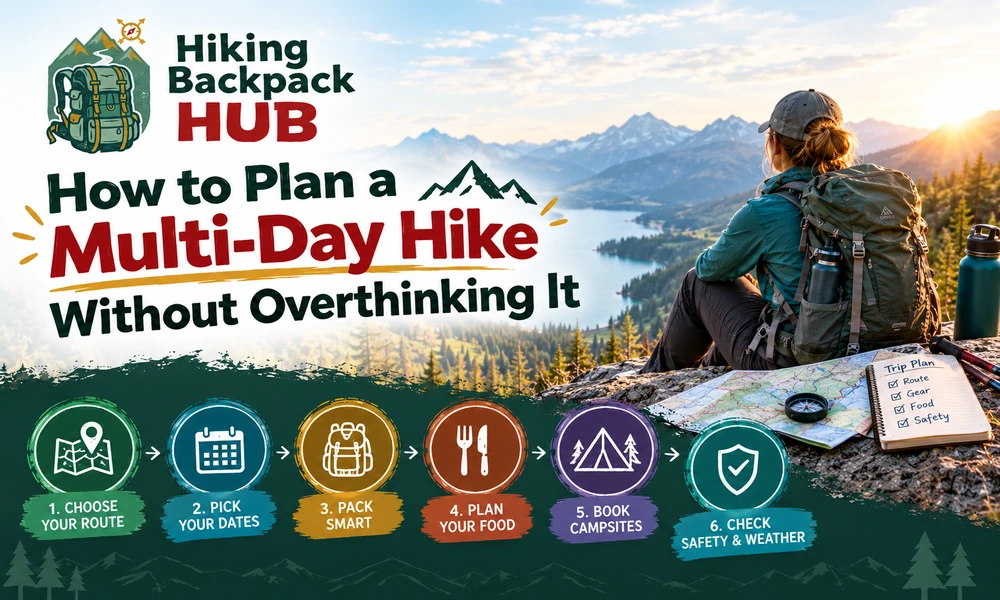
A multi-day hike looks like a huge project from the outside. There is gear to sort, food to pack, permits to check and a route that has to match your legs. The good news is that almost every successful trip follows the same simple sequence. If you work through it in order, planning stops feeling like a mountain of decisions and becomes a short list of small ones. Here is the approach that works for most first-timers and still holds up for experienced walkers.
Start With Distance, Not Destination
It is tempting to pick a famous trail and work backwards. A better habit is to start with how far you can comfortably walk in a day while carrying a full pack. Most people who are fit for day hikes find that eight to twelve miles a day is a sensible ceiling on a first overnight trip, and less if the terrain climbs steadily. Add roughly an hour of walking time for every thousand feet of climbing as a rule of thumb, then add breaks. This gives you a realistic daily range before you look at a single map.
Once you know your range, the destination chooses itself. A three-day trip at ten miles a day suggests a thirty-mile route, and that single number removes most of the trails you were never going to finish anyway. Be honest here. Plans fail far more often because the daily mileage was ambitious than because of weather or gear.
Read the Route Like a Story
A map shows more than the line you will follow. Look at where the climbs fall, where the water is and where the legal campsites sit. A route that stacks all of its climbing into the final afternoon will feel very different from one that starts hard and eases off. Where possible, put your biggest effort on the day you are freshest, usually day one or day two.
Water deserves its own pass. Note every reliable source and every long dry stretch, then decide where you will carry extra. Check recent trip reports or the land manager’s page for conditions, because a spring that flows in June can be dry by September. Treat the map as a draft and the latest conditions report as the correction.
Check Permits, Seasons and Rules Early
Popular routes often require permits, and some release them months ahead. Others restrict camping to designated sites, require bear-resistant food storage or ban fires entirely. These rules are not minor details. They decide where you sleep each night, which in turn decides how far you walk. Read the official page for the land you will be on, not a summary on a forum, and save a copy of your permit where you can reach it without signal.
Season matters just as much. Snow can linger on high passes well into summer, river crossings swell during snowmelt and afternoon storms are common in many mountain ranges. Picking a month with stable conditions is the cheapest safety measure you will ever make.
Build the Pack Around the Plan
Gear is the part most people want to start with, which is why it belongs near the end. When you know the distance, season and terrain, the list almost writes itself. A pack for three dry days in mild weather is a different object from a pack for cold nights above treeline.
A common guideline is to keep your loaded pack to about a fifth of your body weight, or lighter if you can manage it. Treat that as a starting point, not a rule. Weigh your gear, find the heaviest items and ask whether each one earns its place. Your shelter, sleep system and pack are usually the biggest three, so improvements there save the most weight. If you are still deciding between packs, the guides at Hiking Backpack Hub walk through fit and capacity so you do not buy the wrong size.
Whatever you carry, include the basics every time: navigation, sun protection, insulation, light, first aid, fire, repair tools, food, water and emergency shelter. This is often called the ten essentials, and it exists because it has been tested by decades of rescues.
Plan Your Food by the Day
Food is easy to get wrong in both directions. Too little and you will crawl through the last afternoon. Too much and you are carrying pounds of snacks you never touch. A workable starting point is to plan for around one and a half to two pounds of food per person per day, then adjust once you learn your appetite.
Prioritise calories per ounce, but also pack things you actually enjoy eating. A meal you look forward to is worth its weight when you are tired and cold. Pack a small extra portion for each day in case you are delayed, and repackage everything into lightweight bags to cut bulk and waste.
Tell Someone Your Plan
This step takes five minutes and is the one most often skipped. Leave a written plan with a trusted person that includes your route, planned campsites, start and end dates, vehicle details and the time at which they should call for help if you have not checked in. Agree on that time in advance and add a buffer so a slow day does not trigger a false alarm.
If you carry a satellite messenger or personal locator beacon, make sure you understand how it works before the trip, not on the trail. Coverage in the backcountry is unreliable, so download offline maps and carry a paper map and compass.
Do a Shakedown Hike
A short overnight trip close to home reveals nearly every problem a longer trip would. Wear the boots you plan to use, sleep in the tent, cook the meals and carry the pack at its real weight. You will find the hot spot on your heel, the stove that will not light in wind and the item you packed but never touched.
Set a Turnaround Rule
Good plans include a way out. Before you leave, decide what conditions will make you change course: a storm forecast, an injury, a river running higher than expected or simply running behind schedule. Identify at least one bail-out route on the map, such as a trail that drops to a road. Deciding in advance matters because judgment gets worse when you are tired and invested in finishing.
Turning around is not failure; the trail will still be there next season.
Keep the Planning Proportionate
It helps to remember that you do not need a perfect plan, only a safe and flexible one. Know your daily distance, understand your water, carry the essentials, tell someone where you are going and have a way to adjust. Everything else is refinement.
If you want a single place to organise this thinking, the hiking planning guides cover routes, checklists and trip preparation in more detail, so you can build your itinerary step by step rather than all at once. Start small, learn from each trip and let your plans grow with your experience.
About the author: Dana Okoro writes about trail preparation and backpacking at Hiking Backpack Hub. Read more of their work on the author page.